

How to Build a Fine Jewellery Collection That Actually Works Together
How do you purchase jewellery? Or rather, how do you decide whether a piece is worth buying or not? In their early twenties, a number of people invest in buying jewellery collections the same way they build playlists. People often select one song at a time, based entirely on their feelings in that moment, without considering how it all fits together. The result is something personal and full of good individual choices that somehow doesn’t quite cohere when you look at it as a whole.
A ring might have been bought because it was beautiful, a pair of earrings chosen for a specific occasion, or diamond half eternity ring selected five years into a marriage without anyone really contemplating whether it worked with what came before it. Individually, every piece was the right decision. But, together, they’re a collection that has never quite found its identity.
This is the most common jewellery problem in the UK and the least talked about. And it’s almost entirely avoidable; not by following rigid rules, not by buying everything from one place, and not by sacrificing spontaneity for coordination, but by understanding a small number of principles that make the difference between a collection that tells a story and one that’s simply an accumulation of things you’ve liked over the years.
Start With the Anchor Piece
What an Anchor Piece Actually Is
Every outstanding jewellery collection has an anchor. It’s the piece that everything else is in conversation with. For most people in the UK, that anchor is the engagement ring. The engagement rings in the UK are the worn piece every day without question; it sits on the hand that other pieces are chosen to complement, and its metal, stone, and overall character set the visual language for the entire collection that follows.
If you’re planning on making a collection and haven’t chosen your gemstone engagement rings, now is the time to think of it as the foundation of everything else. The metal you choose will be the metal you live with across the rest of your collection unless you make a deliberate decision to mix.
What If Your Anchor Piece Was Chosen Without Thinking About Its Future?
The engagement ring was chosen for what it was, not for what it would anchor. That’s completely fine and completely normal, and it doesn’t mean the collection built around it has to feel like an afterthought.
The principle remains the same: you should utilise what you already possess instead of beginning anew. Look at your engagement ring and ask honestly what its character is. Is it delicate or substantial? Traditional or contemporary? Warm in tone or cool? Does it lean towards colour or towards brilliance? These characteristics serve as your foundation. Every subsequent piece either echoes them, contrasts them deliberately, or simply ignores them.
The Metal Rule That Isn’t Actually a Rule
Why Consistency Matters More Than Matching
There is a widely repeated piece of jewellery advice that says you should match your metals. You should group all yellow gold together, all platinum together, and white gold with white gold. Like most widely repeated advice, it contains a truth that has been simplified past the point of usefulness.
The truth is that metal consistency matters more than metal matching. Those are not the same thing.
Consistency means the metals in your collection have a visual relationship and feel like they belong to the same family, even if they’re not identical. A collection that combines platinum and white gold reads as consistent because both metals are cool-toned and visually similar. A collection that pairs yellow gold with rose gold can work beautifully because both are warm-toned and the contrast between them is soft rather than jarring.
What tends to look unconsidered is a sharp contrast between warm and cool metals in pieces worn simultaneously. Not because there’s a rule against it, but because the visual tension between very different metal temperatures draws the eye to the difference rather than to the pieces themselves.
Where Mixing Metals Works and Where It Doesn’t
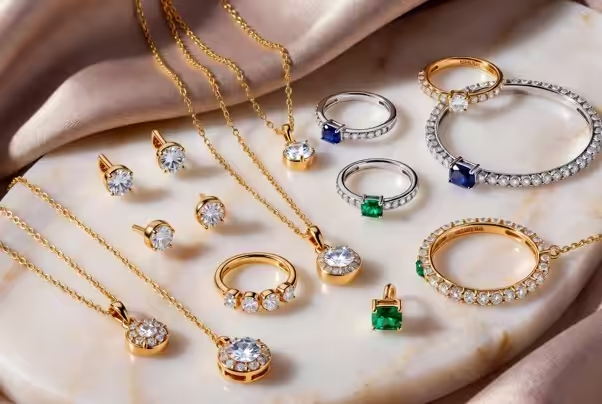
Mixing metals works most successfully when it’s deliberate rather than accidental. A yellow gold engagement ring worn alongside a diamond full eternity ring in yellow gold and emerald earrings set in yellow gold; that’s a collection with a clear, warm, consistent metal story. A platinum engagement ring with a gemstone worn alongside a platinum eternity ring and white gold earrings for everyday—that’s a cool-toned collection with the same kind of coherence.
Where it gets complicated is when pieces from different metal families end up being worn together regularly because each one was chosen independently without reference to what it would sit alongside. If that’s where you are, the solution isn’t to replace anything. It’s to understand which pieces work well together and to be intentional about which combinations you reach for, rather than putting everything on at once and hoping it resolves itself.
Summing Up
To sum up, it may be tempting to purchase jewellery every time you come across something beautiful, individually. But in the long run, even after having a lot of jewellery, you won’t be able to have a set that can be mixed, matched, and worn together. Therefore, it is crucial to clearly understand the jewellery you already own, as this will allow you to mix and match with the new pieces you are purchasing.
Author Bio:
Allen Smith is a passionate content creator and jewellery writer who specialises in natural and lab-grown gemstones. With a keen eye for style, he helps readers build cohesive, versatile fine jewellery collections that stand the test of time.
Allen’s writing combines expert insights on gem quality, ethical sourcing, and practical styling tips — from mixing metals and layering pieces to choosing timeless investment pieces. His approachable and inspiring voice makes fine jewellery accessible and exciting for every enthusia