

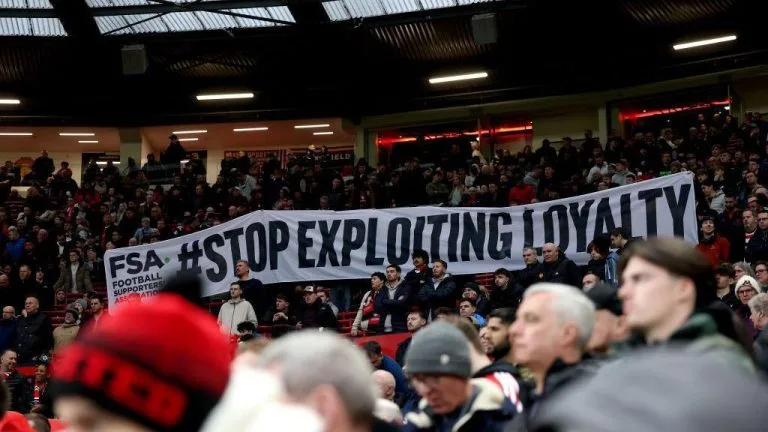
What Modern Football Assumes Fans Will Accept
The modern-day, corporatised football operates on the assumption that supporters will tolerate ticket hikes, schedule changes, and long trophy droughts with only brief protests.
This ‘compliance model’ is built on the belief that fan loyalty is an unbreakable asset. Mainly because we saw how many Liverpool fans waited 30 years for a league title, this shows that clubs use European success to keep fans patient during domestic failures.
The reality is that being a supporter is as much about emotional endurance as it is about sport. This blog hereby includes key insights like:
- The Protest Cycle: Why clubs believe fan anger is temporary?
- The Liverpool Example: How continental trophies mask domestic gaps?
- Patience being Cashed: Why loyalty is now measured by what a fan tolerates?
Club Owners No Longer Fear Small Fan Protests
Is ‘guaranteed fan compliance’ a thing in profit-first football? No.
It is not a written rule in the game, but if you are not new to the game’s commercial era, you know that it often feels like an accepted norm.
The clubs have repeatedly tested fan patience through rising ticket prices, commercial overload, and controversial decisions. Yet history shows that outrage fades faster than loyalty. Especially after moments like the failed European Super League, protests were loud.
But, to no one’s surprise, most fans returned.
That predictable return then eventually allowed clubs to treat emotional attachment as a reliable revenue stream, not a relationship that needs protecting.
Do Football Clubs Think Fans Will Never Leave? WHY?
It is a little heartbreaking to hear the truth, but football in the age of capital is quite selfish. The club owners, to be specific, think of your loyalty as a ‘locked-in asset’.
Apart from this, the governing bodies also make major decisions, like raising ticket prices or moving games to inconvenient Monday nights, without considering fans. They have realised that fans will complain for a few days and then show up anyway.
This assumption is based on the idea that a fan’s connection to their team is different from a customer’s connection to a grocery store.
This means if a store raises prices, buyers go elsewhere. On the contrary, when a football club does the same, they know you can’t simply start supporting a rival. This emotional monopoly allows clubs to test the limits of what a person will accept in the name of loyalty.
Only a few game fans have realized this exploitation and have stood against it.
How Europe Kept the Peace After Liverpool Incident
For thirty years, Liverpool fans waited to be champions of England again. During those decades, the club went through periods of being far away from the top of the Premier League history.
Thinking logically, in any other business, a thirty-year failure to reach the top goal would lead to a total loss of customers. Though in this case, something remotely unexpected happened.
Liverpool’s success in European competitions acted as a ‘patience buffer’, something that meant fans kept tolerating disappointments elsewhere.
Yes, in exchange for the loss of domestic titles, the club won big international club tournaments against top teams and pacified fans, turning their rage into a forgiving mood. The trick worked, and it created a narrative that the team was still elite, without the domestic win.
In Case You Are Wondering How Fans Moved Through the Long Wait
®The Found European Distraction
Big nights in Europe provided the highs needed to survive the lows of the domestic season.
®Legacy Loyalty
The history of the club was used to remind fans that their time would come. Hence, for now, they must stay quiet and keep supporting.
®The Community Bond
The fans also stayed patient because the identity of being a Liverpool supporter was more important than the actual results on the pitch.
Is Endurance the New Definition of Support?
In 2026, being a Good Fan is often described by how much you can endure. We are told that real fans stick by their team through thick and thin. While this does sound noble, it is often used by clubs to justify poor decision-making or a lack of investment.
According to this narrative, the new era supporter is expected to tolerate:
- Ridiculously high costs for tickets and subscriptions.
- Inconvenient scheduling of games, too, on short notice for television companies.
- Lack of transparency when owners don’t include fans in decisions.
Ironically, the fans pay, yet their voices are left out. How does that make any sense? This is exactly what the majority of the game fans have been sleeping on for a couple of years now.
Why Governing Bodies Rely on Brief Protests
When a new rule is introduced, the people in charge expect a flare-up of anger. They know social media will be full of protests, and fans might even hold banners at the stadium.
However, their strategy is simply to wait.
They know that once the whistle blows for the next game, the focus shifts back to the players and the points. Hence, the “Compliance Model” works because the love for the 90 minutes of football is stronger than the anger toward the 24 hours of business.
The Cycle of Fan Compliance
| Four Phases | Action | Outcome |
| The Change | Club increases the ticket price. | Fans feel betrayed |
| The Protest | Social media outrage and banners | Club releases a ‘We hear you’ statement |
| The Distraction | A big win or a new player signing | Fans focus on the sport again |
| Compliance | Fans pay the new price and show up | The change becomes the new normal |
Can Fans Ever Truly Break the Pattern?
We saw a rare break in this pattern during the 2021 Super League protests.
For once, the anger didn’t fade after 48 hours. Because the threat felt like it would ‘kill’ the sport forever, the fans pushed back hard enough to stop the move. But since then, the slow creep has returned. Decisions are now made in smaller steps so that the protests remain brief.
It raises the question: At what point does endurance turn into enablement? If fans keep accepting less for more money, there is no reason for clubs to change their behavior.
FAQs
Why don’t fans just stop going to games?
Showing up completely for the game is next to impossible because a football club is part of their family and identity. Stopping support feels like giving up on a piece of yourself.
How did Liverpool maintain their fan base during the 30-year drought?
They achieved success in Europe and made fans feel part of an exclusive club, unlike anyone else. This made the lack of a league title easier to handle.
Does the ‘Compliance Model’ happen in other sports?
Yes. Many American sports use a franchise model where teams can move cities entirely. In Europe, the model is different, but the assumption is the same.
The Final Word Is That A Fan Is Like A Loyal Customer That Will Never Leave
The media-driven and profit-first football is not very new to the town. It has been testing the limits of a human heart passionate about the game for quite a while now, Author Kristian Russell has written about it.
Though a lot of us have been sleeping on it, how much longer can this continue? Today, we are in a space where clubs and governing bodies view fan loyalty as a predictable data point rather than a passionate relationship. It honestly hurts.
This is direct proof that, as long as fans continue to comply after the briefest of protests, the industry will deliberately prioritize growth over people.