

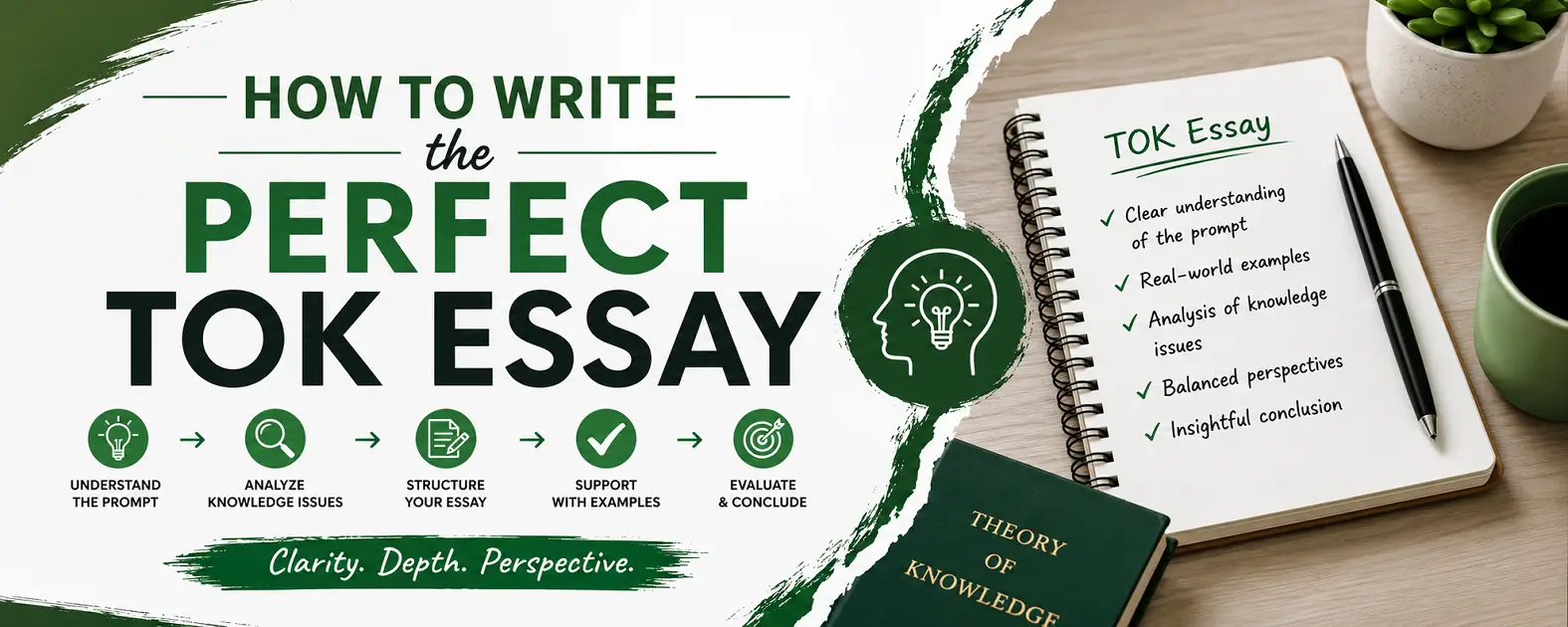
How To Write The Perfect TOK Essay
You open the document, read the prescribed title three times, and still have no idea what it’s actually asking. It sounds less like an essay prompt and more like something a philosophy professor would debate over coffee. That moment of complete blankness is something almost every IB student knows.
However, the TOK essay isn’t as unreachable as it feels in that moment. The problem isn’t your thinking. It’s that nobody walks you through the actual approach in plain terms. We are about to give you some crucial tips and insights from pro IB writers to ace your next TOK essay.
A Guide That Will Help You When You Are Writing Your Next TOK Essay
Most students approach the TOK essay the same way they approach every other assignment. Their focus is on finding information, building an argument, and completing the submission. That approach works everywhere else. In TOK, it’s the exact reason so many essays fall flat.
The examiner isn’t looking for what you know about a subject. They’re looking at how you present your ideas and knowledge, where they come from, how they’re validated, and why we accept some things as true over others.
The Difference Between a Content Claim and a Knowledge Claim
This is the shift that changes everything. A student writing about science might claim that vaccines are effective because clinical trials prove it. That’s a content claim. It states what is known. A TOK essay goes one level deeper and asks what makes a clinical trial a reliable source of knowledge in the first place. Who sets those standards? Could those standards ever be flawed or biased?
The shift from stating a fact to questioning the basis of that fact is the entire foundation of the essay.
Why This Matters Before You Write a Single Word
Students who miss this distinction spend hours writing a beautifully structured essay that answers the wrong kind of question entirely. They describe, inform, summarize, and examiners can tell immediately. TOK rewards analysis over information, and this is precisely what skilled IB writers focus on before a single paragraph gets drafted. Once that registers, the prescribed title stops feeling like a philosophical riddle and starts feeling like an actual question worth engaging with.
Build Your Knowledge Question Before You Write Anything
The prescribed title is the prompt. It is not your essay question. Most students miss that and start writing without ever building a knowledge question first. That’s why their essays wander without landing anywhere.
Weak KQ vs. Sharp KQ
A knowledge question is specific, open-ended, and directly about knowledge itself, not about a subject or event.
Weak KQ: Does science give us the truth?
Sharp KQ: To what extent does the method of verification in natural sciences determine what counts as knowledge?
Same idea but a completely different level of precision. The sharp version gives you a real position to argue and a clear direction from sentence one.
A Format to Start With:
If you’re stuck: “To what extent does [factor] shape what is accepted as knowledge in [area of knowledge]?” Refine it from there. A rough KQ you can sharpen is worth far more than a blank page waiting for a perfect one.
How to Structure Your TOK Essay Paragraph by Paragraph
Most TOK essays don’t fail because of bad ideas. They fail because those ideas never get organized into something an examiner can follow. Structure isn’t a formality here. It is how your thinking becomes visible on the page.
The Framework That Actually Works
Introduction
State your knowledge question clearly and take a position on it. Don’t sit on the fence. Examiners want to see a student who has something to argue, not one who’s still deciding.
Body Paragraph One
Open with your first claim. Support it with an example from your first area of knowledge, something specific, not something vague like “scientists have proven this.” Then introduce a counterargument. Acknowledging the other side isn’t a weakness. It shows the examiner you’re thinking critically rather than just defending one angle.
Body Paragraph Two
Same approach, different area of knowledge. The contrast between your two AOKs is where the essay gets interesting. History and natural sciences. Mathematics and the arts. The combination creates the analytical depth IB markers are specifically looking for.
Conclusion
Don’t summarize. Use this space to show what your argument reveals about knowledge more broadly. What does your essay tell us about how humans understand, question, or justify what they believe to be true?
What To Keep In Mind?
IB markers read hundreds of essays. The ones that stand out don’t have the most examples. They have the clearest thinking. A tight argument with two strong AOKs will always outscore a scattered essay trying to cover everything. If it feels confusions, you can always go for a safer option of hiring a TOK essay writing service.
Mistakes That Actually Cost You Marks
Most TOK essays don’t fail because the student didn’t try. They fail because of a few specific habits that feel completely normal while you’re writing them.
Writing without a knowledge question is the most common one. The student reads the prescribed title, feels like they understand it, and starts writing. Six hundred words in, the essay is technically about the topic but isn’t actually answering anything. Without a KQ anchoring your argument, the whole essay drifts.
Relying on one area of knowledge is the second mistake. TOK is built around the tension between different ways of knowing. An essay drawing from only one AOK reads as incomplete regardless of how well those points are made.
Dropping examples without connecting them is where good essays quietly lose marks. Mentioning Darwin or Einstein and moving on isn’t analysis, it’s decoration. Every example needs to tie directly back to your knowledge question.
Describing instead of analysing is the subtlest mistake of all. The moment your writing starts summarizing events rather than questioning their relationship to knowledge, you’ve crossed from TOK into regular essay territory. Students who catch this pattern late, two days before submission, with no time to restructure, are usually the ones turning to a reliable TOK essay writing help to pull the essay back into shape before the deadline hits.
Frequently Asked Questions
What is a TOK essay?
A 1,600-word IB assignment where you explore knowledge questions across two areas of knowledge in response to a prescribed title.
What is a knowledge question?
It’s the specific question you build from the prescribed title the anchor your entire argument. Without it, the essay loses direction fast.
Can IB writers help with TOK essays?
Yes, whether it’s a full draft, restructure, or final review, experienced IB writers provide support built around IB assessment criteria.
One Last Thing Before You Start Writing
Everything covered in this guide comes down to one shift: stop thinking about what you know and start thinking about how you know it. That’s the essay. Build your knowledge question first, pick a title you can genuinely argue, and let your two AOKs create the contrast that makes your analysis worth reading. The rest is drafting, refining, and being honest with yourself about whether each paragraph is doing real analytical work. Most students get there with enough time and the right approach. For those who need an extra hand, experienced IB writers are always ready to step in, whether that’s a full draft, a restructure, or a final review before submission.
Subscribe now to get the latest blogs, insights, and community updates delivered regularly.