

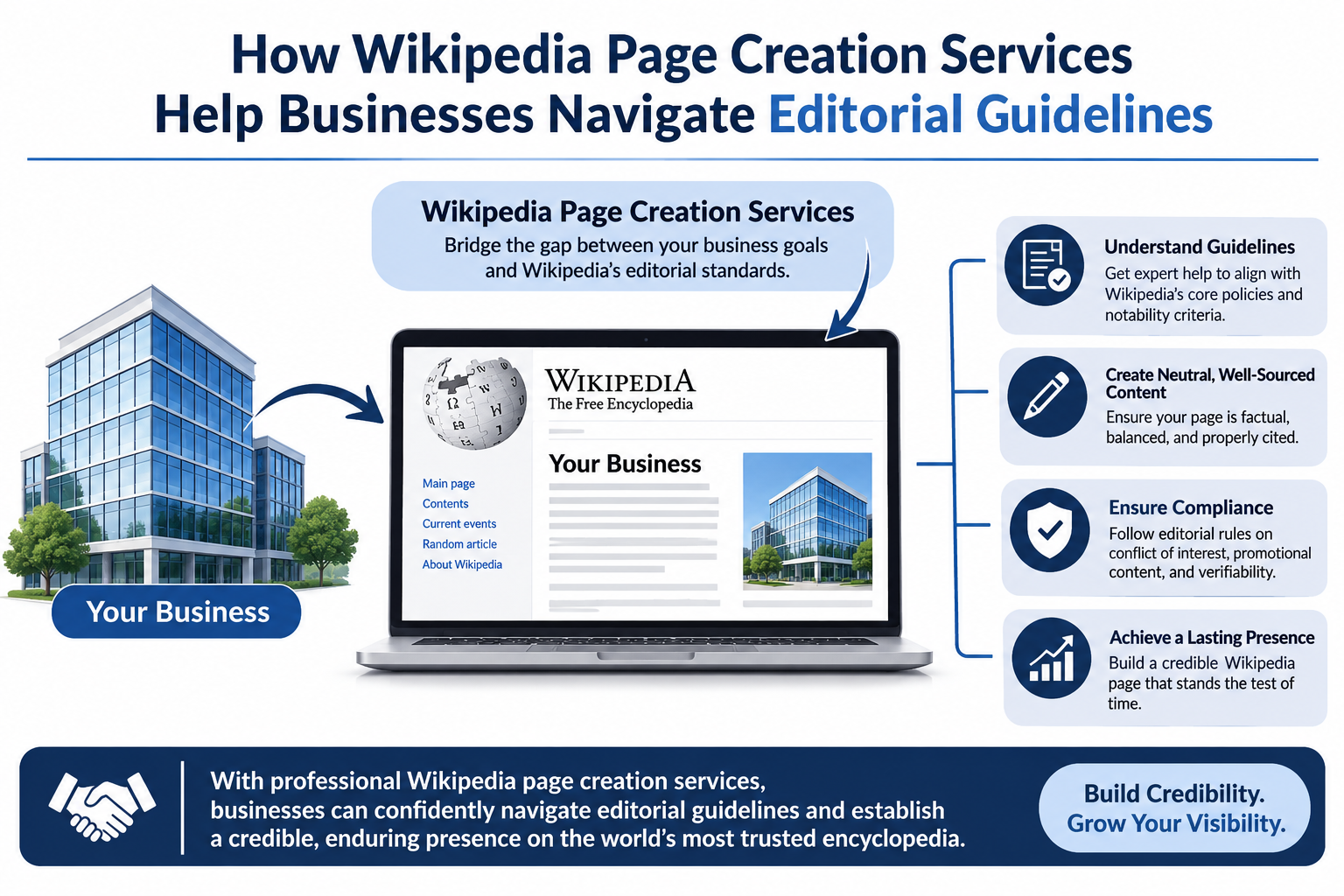
How Wikipedia Page Creation Services Help Businesses Navigate Editorial Guidelines
A company may have a detailed website, active media coverage, and an established business history yet still struggle to understand how Wikipedia evaluates a proposed article. The difficulty is not simply learning the editing interface. It is recognising the difference between encyclopedic documentation and corporate communication, then applying that difference consistently to research, writing, and review.
Businesses comparing a professional services wikipedia page creation for companies should look for clear guidance on source assessment, neutral writing, and conflict of interest obligations. Professional assistance can help organise research and prepare accurate drafts, but it cannot reserve a place in the encyclopedia or overrule volunteer editors. That distinction should shape the entire service relationship, from the initial scope of work to the final handover.
Translate policy language into practical decisions
Wikipedia guidance uses concepts such as significant coverage, independence, reliable sourcing, verifiability, and due weight. These ideas become useful when translated into concrete research choices. An agency might explain why a detailed newspaper investigation is more persuasive for notability than a corporate announcement, or why a statement about market leadership needs more than a company press page. The client should leave the assessment understanding which claims can be included and why other claims should be excluded.
Determine whether a standalone topic is appropriate
A business may request separate articles for its parent company, founder, platform, and products. Not every related subject has independent coverage sufficient for its own page. Consultants should examine the evidence for each proposed topic rather than assume that one notable organisation makes all connected people and products notable. They should also check existing articles to avoid unnecessary duplication. A clear subject boundary gives the draft a coherent opening, structure, and reference strategy.
Develop a research driven article outline
A company brochure often begins with services and selling points. An encyclopedia article generally starts by defining the subject and then summarises verifiable background, history, operations, and significance in proportion to reliable sources. A good outline should arise from the published evidence. If reporting mainly concerns a particular acquisition or controversy, the article should not ignore that fact in favour of several paragraphs of promotional messaging. Neutral structure is as important as neutral adjectives.
Manage claims, images, and copyright
Some clients provide biographies, marketing photographs, logos, and web copy and expect them to be inserted directly. Text copied from a website may violate copyright unless appropriate permissions and licensing conditions are met. Images also require suitable rights and documentation, and a logo may be subject to particular usage constraints. An agency should explain these requirements before submission. For prose, the safest normal practice is to write original summaries based on reliable sources and include only material relevant to an encyclopedia.
Define the agency role and editorial boundaries
A wikipedia page creation service should explain what staff can deliver, such as a source assessment, draft, disclosure, review response, or talk page request. It should also state what remains outside its control. An accepted draft can later be edited or deleted according to community processes. Clients may suggest factual corrections but cannot insist on flattering language or removal of significant well sourced criticism. A clear division between professional preparation and independent editorial decisions prevents unrealistic promises.
Understand the Articles for Creation pathway
The Articles for Creation process allows a draft to be reviewed before publication. Reviewers may accept it, decline it with feedback, or identify issues requiring further work. Review timing depends on volunteer availability and the state of the queue. An agency should not advertise a guaranteed acceptance date. Where a draft is declined, the appropriate response is to analyse the reviewer’s specific concerns and decide whether the underlying evidence supports a meaningful revision.
Handle existing articles without creating disputes
Companies sometimes approach consultants because an existing article contains an outdated leadership title or incorrect date. These situations may call for a documented edit request rather than a new article. Contributors with a financial relationship should disclose it and use suitable channels so uninvolved editors can evaluate the proposed change. If another editor objects, a reasoned discussion is preferable to repeated reversions. Respecting the collaborative process is a practical part of professional service delivery.
Measure service quality beyond publication
The most useful indicators of a consultant’s work are transparent sourcing, accurate factual claims, careful drafting, readable policy explanations, and responsible handling of feedback. A guarantee of publication is not an indicator of expertise because the consultant cannot control independent review. Businesses should ask for a clear methodology and a documented assessment. That evidence makes it possible to judge the quality of the work even when Wikipedia’s final decision is uncertain.
How businesses can assess a consultancy proposal
A buyer can ask for a sample source assessment format, an explanation of disclosure procedures, and a description of the revision process if a draft is declined. The answers should be specific enough to demonstrate an editorial method without revealing confidential client information. Watch for agreements that define success solely as getting any page online, since an unstable promotional article may not serve the client well. Ask whether the consultant distinguishes factual verification from notability and whether there is a policy for refusing weak cases. A reliable proposal should identify the work being purchased and the independent decisions that cannot be purchased. This creates a better foundation for a professional relationship than promises about secret techniques.
Final Thoughts
Wikipedia consulting is most valuable when it helps businesses understand an unfamiliar editorial environment. The service should improve research, accuracy, and transparency while respecting community independence. A strong process teaches clients what can responsibly be proposed, not how to purchase a guaranteed outcome.